
01
Operators need regular access
Loading, inspection, adjustment, or low-volume changeovers require people to approach the work area during defined states.
Robot selection
A cobot is an industrial robot designed for collaborative operation when the full application is risk-assessed. A conventional industrial robot is usually integrated for separated, high-throughput automation. The better choice depends on payload, speed, tooling hazards, access needs, guarding, footprint, and cycle-time targets, not the robot category alone.
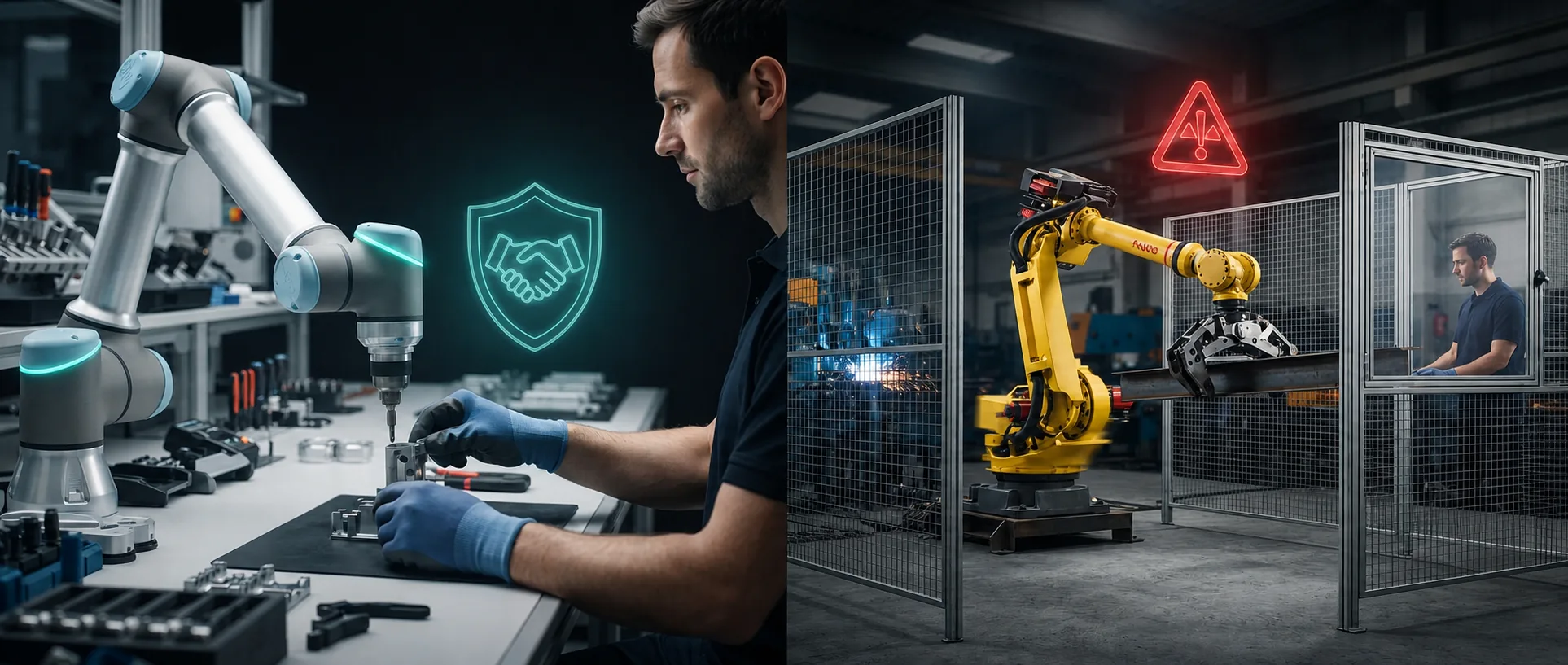
The categories overlap, so the useful comparison is application-level: task, tool, workpiece, access, safety concept, cycle time, and full cell cost.
| Criteria | Cobot | Industrial robot |
|---|---|---|
Payload and speed | Compare rated payload with reach, center of mass, wrist limits, tooling mass, and the allowed operating mode. Collaborative operation can require slower validated motion. | Often selected when sustained speed, high dynamic loading, stiffness, or larger payload families dominate inside a safeguarded cell. |
Safety design | Designed with collaborative functions such as monitored stop, speed and separation monitoring, hand guiding, or power and force limiting. The application still needs risk assessment. | Usually designed around separated operation, with safety systems controlling access to protected space while the robot performs automatic motion. |
Guarding requirements | Can support fenceless or reduced-guarding layouts only when the tool, part, speed, access pattern, and residual risks are validated. | Commonly uses physical guarding, interlocks, scanners, or controlled access. This can be simpler when people do not need frequent access during motion. |
Footprint and access | Often useful where floor space is tight, operators share the work area, or the automation cell may need reconfiguration. | May need more protected area, but can fit dedicated lines with fixed conveyors, fixtures, loaders, and peripheral equipment. |
Cost profile | May reduce guarding or deployment complexity for suitable tasks, but tooling, validation, cycle limits, and process fixtures still drive real cost. | May cost more to guard and integrate, but can be justified by throughput, uptime, stiffness, payload, or full-line automation goals. |
A cobot is worth screening when human access, flexibility, and task fit matter more than maximum separated-cell throughput.
01
Loading, inspection, adjustment, or low-volume changeovers require people to approach the work area during defined states.
02
The load, tool, reach, and wrist limits fit available cobot models, and redeployment or mixed production has value.
03
The goal is to remove repetitive handling, awkward reach, or process exposure without rebuilding the whole line.
04
A compact cell with shared access is more realistic than a large protected area, provided the risk assessment supports it.
A conventional industrial robot is often the stronger candidate when the process is dedicated, separated, and throughput-driven.
01
The application needs sustained automatic motion and the cycle target leaves little room for collaborative speed limits or manual handoffs.
02
The part, gripper, reach, wrist moment, or dynamic loading exceeds practical cobot model ranges for the task.
03
Hot, sharp, high-energy, dusty, or otherwise hazardous tooling and parts make a protected cell the clearer safety concept.
04
People do not need routine access during motion, and conveyors, feeders, fixtures, or machine interfaces define a dedicated cell.
Most selection mistakes come from treating a robot category as a guarantee. These distinctions keep the screening decision grounded in the actual application.
MYTH 01
Not automatically. Safety is decided at the application level. Tooling, part mass, pinch points, speed, access, and validation determine whether people can safely share the workspace.
MYTH 02
Not as a universal rule. Useful cycle time depends on model, path, payload, acceleration, tooling, safety concept, loading, and handoff time. Industrial robots tend to win when sustained high-speed separated motion dominates.
MYTH 03
Payload matters, but it must be checked with reach, center of mass, wrist torque, dynamic motion, gripper mass, part presentation, and the validated operating mode.
MYTH 04
Incorrect. A collaborative robot can still need guarding, scanners, stops, reduced speeds, or other protective measures when the complete application creates unacceptable risk.
These questions cover the early screening decision before a detailed integrator quote or risk assessment.
FAQ 01
In practical automation planning, yes. A cobot is an industrial robot designed with collaborative capabilities, but the complete application still decides whether collaborative operation is safe and useful.
FAQ 02
There is no universal cheaper option. Compare the full cell: robot, tooling, fixtures, guarding, safety validation, programming, installation, maintenance, throughput, and operator workflow.
FAQ 03
It can be integrated with safety-rated systems and controlled access, but the risk assessment and safeguarding concept decide how people may approach the cell and under which operating states.
FAQ 04
Ask for both when payload, cycle time, access, cell footprint, guarding, or process hazards are close to the boundary. Send task details, part data, tooling assumptions, layout, target cycle, and access needs.
Use the Project Builder to document the application, payload, region, and constraints. It is not a final engineering decision, but it gives an integrator the context needed to compare cobot and industrial robot fit.
Select one vertical below to calibrate kinematic calculations.