
Collaborative operation
A collaborative application can use safety-rated functions to control how people and robot motion share a workspace. The robot label alone does not make the finished cell safe.
Collaborative robot basics
A cobot, or collaborative robot, is an industrial robot designed with control and safety functions that can support shared work with people when the complete application is properly engineered and risk-assessed. Unlike a conventional robot cell that normally separates people from robot motion, a collaborative application may allow closer interaction under validated operating limits.
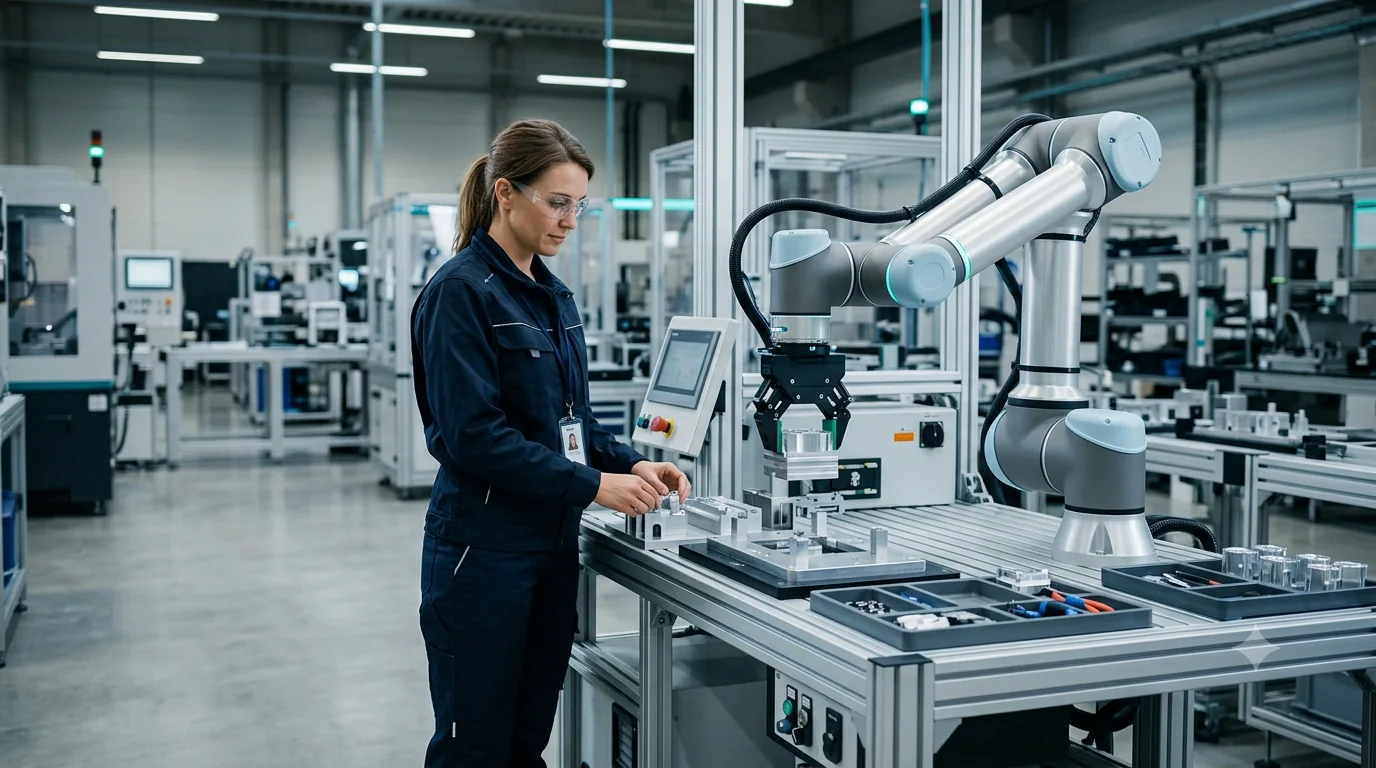
The practical difference is not a single payload or speed threshold. Cobots provide collaborative operating capabilities, while traditional industrial robot systems are commonly optimized for separated, high-throughput cells. Model ranges overlap, so manufacturers should compare the complete task, motion profile, tooling, guarding concept, access needs, and required cycle time before choosing a category.
A collaborative application can use safety-rated functions to control how people and robot motion share a workspace. The robot label alone does not make the finished cell safe.
A conventional robot cell may be preferable when sustained speed, high dynamic loads, rigidity, or complete process separation are the dominant requirements.
Payload, reach, tool hazards, workpiece geometry, access, foreseeable misuse, and production targets must be assessed together rather than treated as category rules.
Use the cobot versus industrial robot decision matrix for application screening. It compares task indicators in context without turning payload, speed, or human access into absolute selection rules.For the deeper comparison, read the cobot vs industrial robot selection guide.
A cobot combines a multi-axis robot arm, controller, software, sensing, and application-specific tooling. Its controller executes programmed motion while safety-rated functions supervise defined limits or operating states. The way those functions are used depends on the task, tool, workpiece, layout, and risk assessment—not simply on the robot being marketed as collaborative.
01
Joint encoders track robot position across the arm's degrees of freedom, while supported platforms may use joint-torque estimation or dedicated force/torque sensing to detect contact and guide process control. Available sensing, repeatability, and safety ratings vary by model, controller, and software configuration.
Glossary:DOFrepeatability
Compare controller and sensing specifications02
Depending on the engineered application, the system may use a safety-rated monitored stop, speed and separation monitoring, hand guiding, or power and force limiting. These are application methods with specific validation requirements, not interchangeable marketing features.
Prepare safety standards and validation scope03
Operators or integrators define poses, paths, speeds, logic, and machine signals through the controller. The end-of-arm tool then performs the real process, so grippers, torches, sensors, fixtures, and interfaces are part of the system design.
Glossary:EOAT
Check payload and tooling requirementsCobots are commonly evaluated for structured, repeatable tasks where ergonomic relief, flexible access, or faster deployment matters. Suitability still depends on cycle time, payload at reach, tooling, process hazards, part presentation, and safety validation. Use the focused workflow pages below to move from a general definition to application-specific engineering questions.
Review MIG/TIG workflow, torch integration, fixturing, seam consistency, and process safeguarding.
Review welding automation workflowsEvaluate box mass, stack pattern, reach, gripper design, cycle target, and end-of-line access.
Evaluate palletizing requirementsCompare machine interfaces, part presentation, dual-gripper logic, door control, and unattended operation.
Compare CNC tending workflowsPlan part handling, insertion, inspection, packing, compliance, vision, and repeatability requirements.
Plan pick-and-place workflowsA cobot is worth screening when the task is repeatable, the load and reach fit an available model, and the process can be engineered around safe human access. It is not automatically the right answer for every manual task. Start with the decision matrix, then use the Project Builder to document the application for integrator review.
Definition answers
These answers clarify common definitional questions before a manufacturer starts model selection or requests a quote. They focus on what a cobot is, how the category is used, and what still has to be engineered at cell level. Detailed payload, brand, standards, cost, and ROI questions remain in the technical cobot hub.
FAQ 01
A cobot is a type of industrial robot arm with collaborative capabilities, but a robot arm alone is not a complete collaborative application. The installed system also includes a controller, software, end-of-arm tooling, fixtures, process equipment, machine interfaces, and a safety concept. Whether people can work near the system depends on the completed application and its risk assessment, not only on the robot model.
FAQ 02
No. Collaborative operation can be designed around different methods, including a safety-rated monitored stop, hand guiding, speed and separation monitoring, or power and force limiting. A project may use one method, combine methods, or require additional protective measures. The chosen approach depends on the process, hazards, access pattern, tool, workpiece, stopping performance, and applicable safety validation.
FAQ 03
Programming normally combines a graphical interface, taught positions, motion commands, process parameters, and signals exchanged with tools or other machines. Some platforms support hand-guided teaching, but the final program still needs controlled speeds, paths, error handling, recovery logic, and validated process conditions. Integrators typically add tooling control, PLC communication, vision, safety logic, and acceptance tests around the robot program.
FAQ 04
A cobot can be easier to redeploy than a fixed automation cell when mounting, tooling, controls, and production interfaces were designed for change. Redeployment is not simply moving the arm: the new load case, reach, centre of mass, fixtures, process hazards, safety functions, software, and risk assessment must be reviewed. Treat flexibility as an engineering objective that is designed into the system from the start.
For model selection, payload, standards, cost, and ROI questions, continue to the technical cobot selection FAQ.
Select one vertical below to calibrate kinematic calculations.